


Author: Jan Matejko
Year: 1883
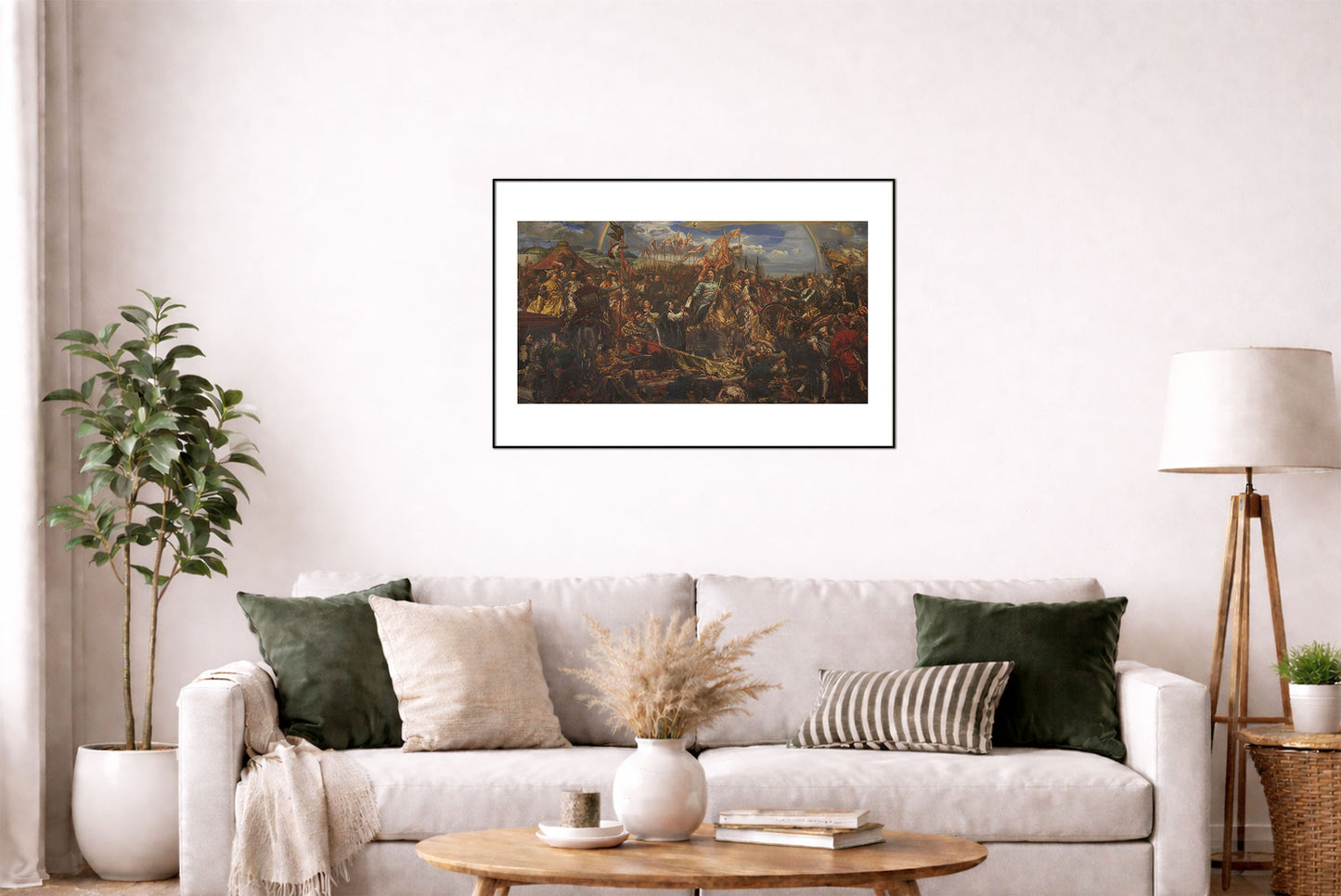
This is a reproduction print of Jan Matejko’s monumental historical painting Jan III Sobieski at Vienna, created in 1883 to commemorate the 200th anniversary of the Relief of Vienna. The original is an oil painting on canvas measuring approximately 458 × 894 cm and is preserved in the Vatican Museums in Rome.
Composition and Subject Matter:
The painting depicts the aftermath of the Battle of Vienna on 12 September 1683, rather than the battle itself. At the center, King Jan III Sobieski sits on horseback and hands a letter announcing the Christian victory to Jan Denhoff, who is to deliver it to Pope Innocent XI. Behind Sobieski are Polish cavalry and the famous winged hussars, while the defeated Ottoman camp and the landscape around Vienna form the background.
The composition brings together Polish, Imperial and German commanders, emphasizing the international character of the relief of Vienna. Among those represented are Charles V, Duke of Lorraine, Ernst Rüdiger von Starhemberg, and other commanders of the allied forces. The Polish king nevertheless dominates the composition, presenting the victory as a major contribution of Poland to the defense of Christian Europe.
Historical and Cultural Context:
Matejko began the final monumental version in 1882 and completed it in August 1883, specifically in connection with the bicentenary of the victory. The painting was first exhibited in Kraków and subsequently taken to Vienna, where it formed part of the celebrations marking the anniversary. Matejko intended the work to emphasize the role of Sobieski and the Polish army at a time when the Austrian interpretation of the victory tended to minimize their contribution.
The painting was subsequently presented by Matejko as a gift from the Polish nation to Pope Leo XIII. It arrived in the Vatican in December 1883 and remains in the Sala Sobieski of the Vatican Museums. Pope Leo XIII awarded Matejko the Commander's Cross with Star of the Order of Pius IX for the work.
Notable Features:
- Jan III Sobieski: The central figure, portrayed immediately after the victory, embodies the military leadership of the Polish-Lithuanian Commonwealth.
- Winged Hussars: Polish hussars with their distinctive wings and banners appear behind the king, forming one of the most recognizable elements of the composition.
- Jan Denhoff: The canon receives Sobieski's letter intended for Pope Innocent XI, establishing the central narrative of the painting.
- Vienna: The city and the surrounding landscape appear behind the figures, connecting the monumental scene directly to the historical battlefield.
- Ottoman Camp: Turkish tents and military equipment remain visible, providing a visual reminder of the defeated Ottoman army.
- Religious Symbolism: The presence of the papal message and religious figures presents the victory within the broader context of Christian Europe.
- Monumental Scale: At almost 9 meters wide, the original was conceived as a monumental historical statement rather than simply a battle scene.
The painting is therefore both a historical representation of the 1683 victory and a powerful statement about Poland's place in European history. Matejko transformed the event into a national and diplomatic image, presenting Sobieski as the Polish leader whose victory was offered to the wider Christian world.
Strategy Maps